



Peanut butter producers need to deliver the same texture, appearance, and stability in every jar, both at filling and through the product’s shelf life. Oil separation during storage is a common issue in this application, and it is closely linked to how peanut butter is finished and transferred before filling.
Challenge: Preventing oil separation in storage
Oil separation occurs when the finished product leaves the line in an unstable state. Peanut butter is a high-viscosity, oil-continuous suspension; if it exits too warm or unevenly cooled, the oil phase remains mobile and gradually separates over time. The result is an oil layer on the surface and a product that feels less consistent.
When production is scaled to continuous industrial operation, this becomes harder to control. Long runs and high throughput require stable finishing without unnecessary stoppages. Conventional cooling equipment often struggles here because viscous products build up on heat-transfer surfaces. That leads to uneven cooling, more cleaning stops, and higher maintenance demand. Reducing downtime and maintenance while keeping product quality stable is therefore essential.
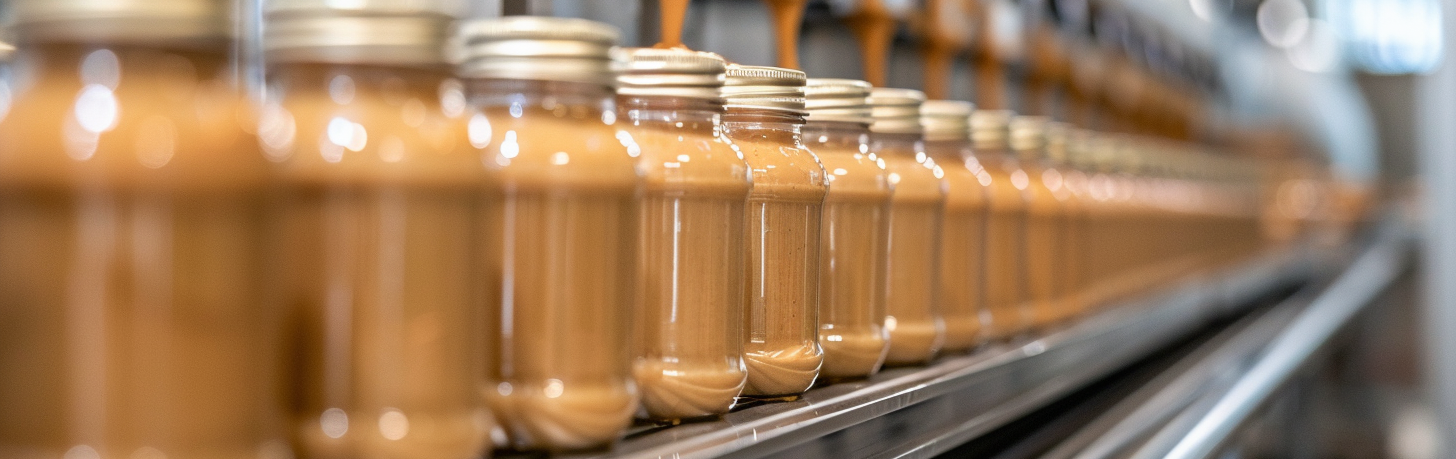
Solution: Votator II scraped-surface cooling with Universal 1 pumping
AxFlow provides solutions for peanut butter finishing built around two complementary technologies.
The finishing step is handled by a Waukesha Cherry-Burrell Votator II Scraped Surface Heat Exchanger. 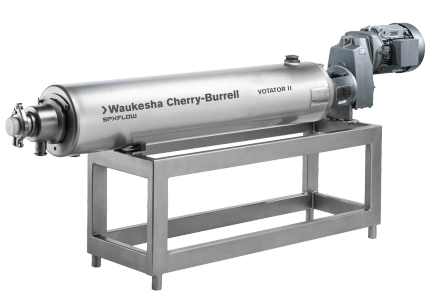 Scraped-surface cooling is important in peanut butter because standard heat exchangers can foul quickly and cool unevenly at this viscosity. The Votator II uses an eccentric scraper blade rotation that continuously renews the heat-transfer surface as product passes through. This improves heat transfer, limits buildup, and ensures uniform cooling across the full product stream during long production runs. The result is tight, repeatable exit-temperature control, which is the key factor in preventing oil separation.
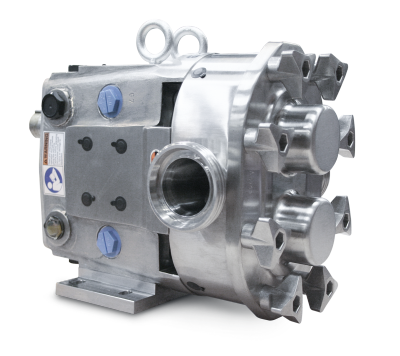 To keep residence time and temperature control consistent in real production, the Votator II is paired with a Waukesha Cherry-Burrell Universal 1 circumferential piston pump. The Universal 1 provides smooth, predictable volumetric flow for viscous, solids-bearing products like peanut butter. In the original setup, two Universal 1 pump sizes are used to suit different duties in the line. In practice, this usually means one size is selected for stable feed into the finishing stage and another for reliable transfer onward to packaging, depending on line layout and capacity. Either way, the purpose is the same: steady flow through the heat exchanger and gentle handling of the finished product.
Result: Stable product quality with lower downtime
With uniform scraped-surface cooling and stable, low-shear transfer, peanut butter leaves the line in a condition that reduces oil migration during storage. Producers can maintain consistent texture and appearance in continuous, high-throughput production, while also cutting the fouling-related interruptions that drive downtime and maintenance in viscous food applications. Oil separation is strongly reduced, quality becomes more repeatable, and the finishing section remains reliable over long runs.
In short, the combination of Votator II scraped-surface finishing with eccentric scraper blades and Universal 1 circumferential piston pumping provides a stable and scalable route to shelf-reliable peanut butter quality.
