What Is Automated Leak Testing?
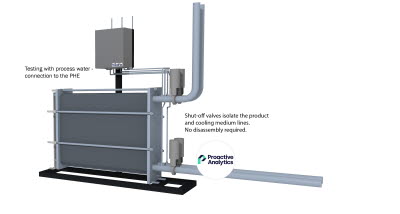
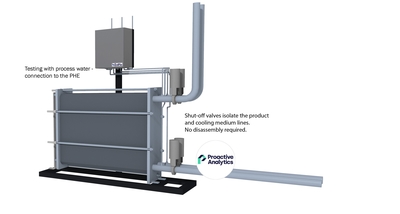
Automated leak testing is performed via an inline test system that remains permanently connected to the heat exchanger. This eliminates the need to manually disconnect piping for the test. The self-calibrating system performs short, automatic tests following daily CIP cleaning and detects microcracks as small as 30 μm. This results in up-to-date, fully transparent insights into the condition of the heat exchanger. Detailed information on the procedure and technical setup of the automated leak testing is available here.
Cost Savings and Efficiency Gains
Conventional methods for heat exchanger integrity testing are often outdated and no longer meet modern efficiency and technological standards. Using automated inline testing can reduce operating costs by up to 50%, depending on the system.
Lowering the Pressure Differential Between Product and Utility Side
In hygienic plate heat exchangers, the product side is typically subjected to significantly higher pressure than the utility side for safety reasons. Daily testing and early detection of microcracks allow for a substantial reduction in pressure differential. This leads to lower energy consumption and a reduction in operating costs of up to 36%. Additionally, reduced wear on plates and gaskets cuts downtime and maintenance costs by around 20%.
Enhancing Heat Transfer
Water is commonly used as the cooling medium in hygienic systems, although glycol, for example, has four times the heat absorption capacity. By detecting microcracks under 30 μm in real time, more effective cooling media can be used. This can increase heat transfer by a factor of four.
If a leak exists in pressurized systems, heated product may enter the cooling medium, significantly decreasing its effectiveness. Lowering the pressure on the product side can prevent efficiency losses of up to 18%.
Boosting Profitability
Many SCADA systems automatically increase pump performance to compensate for pressure loss caused by leaks. This raises the energy demand of the pumps. Moreover, cracks may enlarge under increased pressure, triggering further pump adjustments. To maintain the desired heat transfer, the process must be slowed down, potentially reducing plant profitability by up to 20%. With full transparency into the system's condition, target heat transfer can be maintained at full flow rates.
Automated Leak Testing with ExiFlo
With decades of experience in food and beverage industry processes, we offer expert advice on hygienic heat exchangers and cost-effective condition monitoring. Contact us now for a no-obligation consultation!
White paper picture
Whitepaper: Cost Savings in Heat Exchanger Leak Testing (PDF)