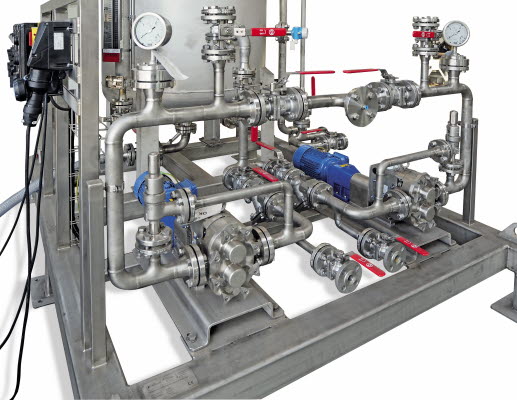



Dosing and metering pumps deliver controlled quantities of liquid into a process. They are used for chemical dosing, pH adjustment, disinfection, additive injection, proportional blending and high-pressure chemical injection.
AxFlow supplies diaphragm, plunger, peristaltic and rotary gear pump technologies for applications across water treatment, chemical processing, oil and gas, power generation, food and beverage, agriculture and general industry.
What Is the Difference Between a Dosing Pump and a Metering Pump?
Dosing describes the controlled addition of liquid to a process. It is a broad term that can include several different pump technologies.
A controlled-volume metering pump is a reciprocating positive displacement pump designed to deliver an accurate, repeatable and adjustable flow. All metering pumps can be used for dosing, but not every pump used for dosing is a controlled-volume metering pump.
How Does a Metering Pump Work?
Diaphragm and plunger metering pumps use a reciprocating action to draw liquid through an inlet check valve and discharge it through an outlet check valve. Flow is adjusted through stroke length, stroke frequency or drive speed, depending on the pump design.
Peristaltic dosing pumps move liquid by compressing a flexible tube, while rotary gear pumps transfer controlled volumes between rotating gears. Reciprocating metering pumps produce pulsating flow, so correct pipework and accessories such as pulsation dampeners or backpressure valves may be required.
Why Choose a Dosing or Metering Pump?
Correctly selected dosing and metering pumps provide:
- Accurate and repeatable liquid addition
- Adjustable flow for changing process demands
- Manual or automated process control
- Options for low-flow and high-pressure duties
- Materials suitable for corrosive chemicals
- Technologies for viscous, shear-sensitive or solids-containing fluids
- Reliable integration into chemical dosing systems and pump skids
AxFlow Supply a range of Dosing and Metering Pumps
Please click the icon .....





Dosing and Metering Pump Applications
Water and Wastewater Treatment
Chemical dosing pumps are used for:
- Sodium hypochlorite dosing
- pH adjustment
- Ferric chloride and coagulant dosing
- Polymer addition
- Fluoridation
- Dechlorination
- Odour control
Chemical and Process Industries
Metering pumps provide controlled addition of acids, alkalis, catalysts, additives, dyes, surfactants, resins and other process chemicals.
Oil, Gas and Petrochemical
High-pressure metering pumps are used to inject corrosion inhibitors, scale inhibitors, methanol, monoethylene glycol and other production chemicals.
Food, Beverage and Pharmaceutical Processing
Suitable dosing pumps can be used for ingredients, flavourings, colourings, enzymes, process additives and cleaning chemicals where the required hygiene and material standards are met.
Agriculture and Fertigation
Dosing pumps provide controlled addition of nutrients, fertilisers and treatment chemicals into irrigation and water systems.
These are established applications for controlled chemical feed and metering technologies across industrial and municipal processes.
How to Choose a Dosing or Metering Pump
Start with three questions: what liquid is being pumped, how much is required and against what pressure?
Then consider:
- Flow range – Define the minimum, normal and maximum dosing rate.
- Accuracy and repeatability – Specify how close the dose must be to the target and how consistently it must be repeated.
- Discharge pressure – Include system pressure, injection pressure and pipework losses.
- Chemical compatibility – Check the pump head, diaphragm, tube, seals and valve materials against the chemical and temperature.
- Fluid behaviour – Consider viscosity, solids, crystallisation, gas release and shear sensitivity.
- Suction conditions – Review tank level, suction lift, pipe diameter and inlet restrictions.
- Process control – Identify whether manual adjustment, pulse control, 4–20 mA input or flow-paced dosing is required.
- Standards and environment – Consider API 675, ATEX, hygienic requirements and site specifications where applicable.
- Maintenance – Account for diaphragm, valve, packing or tube replacement and the ease of calibration.
Stable suction conditions, correct pipework and suitable backpressure are important for achieving consistent metering performance.