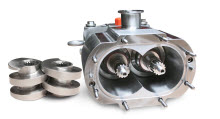


Pumping high viscosity liquids requires specialist pump technologies capable of handling thick, slow-flowing and often shear-sensitive fluids. Whether transferring chocolate, polymers, sludge, adhesives, syrups or cosmetic creams, selecting the correct pump improves process efficiency, protects product quality and reduces maintenance. Positive displacement pumps are typically the preferred solution because they deliver a consistent flow even as viscosity increases.
What are high viscosity fluids?
Viscosity is a measure of a fluid's resistance to flow. The higher the viscosity, the thicker the liquid and the more energy is required to pump it.
Common examples of high viscosity liquids include:
- Chocolate
- Syrups and molasses
- Honey
- Adhesives and resins
- Paints and coatings
- Polymers
- Sludge
- Cosmetic creams and gels
- Oils and greases
Many of these products are also shear-sensitive or contain suspended solids, making pump selection even more important.
Why Rheology Matters
While viscosity measures a fluid's resistance to flow, many industrial products are non-Newtonian, meaning their viscosity changes when subjected to shear. Products such as sludge, polymers, chocolate and cosmetic creams may become easier to pump as they begin to flow, while others behave differently under changing process conditions. Understanding both viscosity and rheology helps engineers select the most appropriate pump technology for reliable, efficient operation.
Why high viscosity changes pump selection
As viscosity increases, centrifugal pumps become progressively less effective and can recirculate fluid within the pump head. For thicker products, a positive displacement pump is typically required. Pumps for high viscosity duties commonly use larger inlets and slower running speeds, improving efficiency and reducing shear compared with centrifugal designs.
Here are the typical maximum viscosties of most common pump types.
- AODD pumps: up to 20,000 cP
- Centrifugal pumps: up to 200 cP
- Circumferential piston pumps: up to 1,000,000 cP
- Eccentric disc pumps: up to 3,000 cP
- Gear pumps: up to 1,000,000 cP
- Metering pumps: up to 5,000 cP
- Peristaltic hose pumps: up to 25,000 cP
- Peristaltic tube pumps: up to 10,000 cP
- Rotary lobe pumps: up to 700 cP
- Rotary vane pumps: up to 22,000 cP
As the density and thickness of a fluid increases, it becomes increasingly difficult to flow and pump with a centrifugal pump. Typically the thicker the fluid a different technology is required being positive displacement pumps, as with a centrifugal pump the thicker the fluid is the more it recirculates within the pump head.
Pumps which handle high viscosity fluids typically have larger inlets, run slower, and are consequently more efficient with such fluids than a centrifugal pump. Pumping high viscosity liquids require careful handling to prevent changes to its consistency, ensure parts of the liquid do not separate out and that solids remain in suspension.
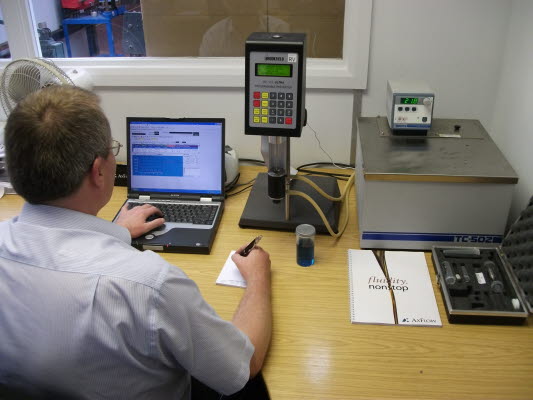
The secret to handling viscose fluids sucessfully is a wide range of pump types something that AxFlow has in abundance.These are supported by our UK and international expertise and ability to measure fluid viscosities with our rheometer.
We are also able to supply systems that incorporate mechanical pump feeders and bridge breakers.
Why is viscosity an important factor when selecting a pump
Viscosity is an highly important factor to consider when selecting a pump because it directly affects the pump's ability to efficiently transport liquids or fluids.
-
Viscosity Variation with Temperature: Viscosity changes with temperature, affecting the fluid's flow properties. Effective pumping solutions must accommodate variations, ensuring consistent performance across different temperature ranges.
-
Resistance to Flow: Highly viscous fluids resist flow, making it challenging to pump them efficiently. As viscosity increases, traditional centrifugal pumps become less effective, necessitating alternative technologies for successful pumping.
-
Preventing Separation and Suspension Issues: Certain viscous fluids contain solids or particles. Careful handling is vital to prevent separation, ensuring uniform consistency and suspension of solids within the liquid.
-
Cavitation Risk: High-viscosity fluids can increase the risk of cavitation, which occurs when the pressure in the pump drops to a level where the fluid vaporizes and forms cavities or bubbles.
- Maintenance and Longevity: The viscosity of the fluid can also impact the wear and tear on pump components. High-viscosity fluids may cause more significant wear on impellers, seals, and bearings, potentially leading to increased maintenance requirements and shorter pump lifespan.
Pumps which handle high viscosity typically have larger inlets, run slower, and are consequently more efficient with such fluids than a centrifugal pump. Some high viscosity liquids require careful handling to prevent changes to its consistency, ensure parts of the liquid do not separate out and that solids remain in suspension.
Successful handling of highly viscous fluids involves understanding viscosity changes, selecting appropriate pump types, and implementing precise operational techniques. With a wide array of pump technologies and expertise, AxFlow ensures efficient and reliable solutions for pumping challenges posed by viscous substances, ensuring consistency and quality across various industrial applications.
How to Choose the Right Pump for High Viscosity Liquids
Choosing the correct pump depends on more than viscosity alone. Engineers should also consider:
- Flow rate and discharge pressure
- Fluid viscosity and temperature
- Solids content and particle size
- Abrasiveness
- Shear sensitivity
- Chemical compatibility
- Hygienic requirements
- Installation conditions
AxFlow's application engineers assess the complete pumping duty before recommending the most suitable pump technology, helping maximise reliability, efficiency and whole-life performance.
Frequently Asked Questions
What pump is best for high viscosity liquids?
Positive displacement pumps are generally the preferred choice for high viscosity liquids because they maintain a consistent flow as viscosity increases. The most suitable technology depends on the fluid properties and application.
Can centrifugal pumps handle high viscosity liquids?
Centrifugal pumps can handle some moderately viscous fluids, but their efficiency typically decreases as viscosity increases. Positive displacement pumps are often more suitable for thick or highly viscous products.
What industries pump high viscosity liquids?
High viscosity liquids are commonly pumped in the food and beverage, chemical, pharmaceutical, cosmetics, mining, paper, and water treatment industries.
How is viscosity measured?
Viscosity is commonly measured in centipoise (cP) or millipascal-seconds (mPa·s). Higher values indicate greater resistance to flow and influence pump selection and system design.