Pumping Corrosive Slurries
Transferring abrasive limestone slurry and chemically corrosive gypsum
Pumping corrosive slurries is one of the toughest duties in process industry. The pump must resist chemical attack from aggressive liquids while also withstanding abrasive wear from suspended solids. AxFlow supplies robust slurry pumping solutions for applications where reliability, containment and material compatibility are critical—including power generation, chemical processing, water treatment and flue gas desulphurisation systems.
What makes corrosive slurries difficult to pump?
Corrosive slurries combine two failure risks in one duty: corrosion and abrasion. Standard pump materials may be chemically attacked by the liquid phase, while suspended solids can erode impellers, casings, liners and seals. Selecting the right pump therefore depends on understanding the complete duty—not just the flow and head.
Key factors include:
- Chemical composition and concentration
- pH and temperature
- Solids content and particle size
- Abrasiveness of the solids
- Required flow rate and total head
- Seal arrangement and containment requirements
- Hazardous area or ATEX requirements
- Maintenance access and expected operating hours
Typical corrosive slurry applications
AxFlow supports corrosive and abrasive slurry duties including:
- Limestone slurry transfer
- Gypsum slurry transfer
- Flue gas desulphurisation (FGD) systems
- Scrubber slurry circulation and transfer
- Chemical process slurries
- Wastewater and effluent treatment slurries
- Mineral and solids-laden corrosive liquids
- Environmentally critical 24/7 process duties
Case study: corrosive and abrasive slurry transfer in power generation
A power generation customer needed to transfer abrasive limestone slurry and chemically corrosive gypsum slurry as part of a large flue gas scrubbing system. The process was environmentally critical, operating continuously, and located within a hazardous area.
Challenge
The pumps had to handle:
- Abrasive limestone slurry
- Chemically corrosive and abrasive gypsum slurry
- Continuous 24/7 operation
- Hazardous area requirements
- High reliability expectations for an environmentally critical process
Solution
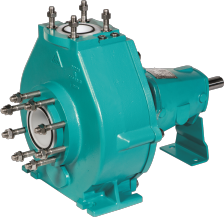
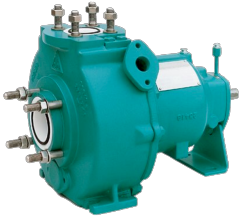
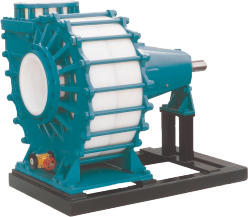
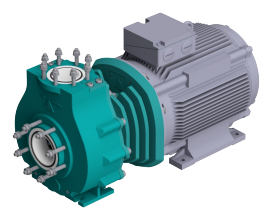
AxFlow supplied ATEX-certified Wernert NE ISO 2858 lined pumps fitted with double mechanical self-flushing seals. The pumps were lined with ultra-high-molecular-weight polyethylene (UHMPE), selected for its combination of abrasion resistance and chemical resistance.
Why UHMPE lining was selected
Ultra-high-molecular-weight polyethylene (UHMPE) has extremely long molecular chains that transfer load effectively, creating a tough lining material with very high impact strength. It also has a low coefficient of friction and self-lubricating properties, helping it resist abrasion from gypsum and limestone slurries.
UHMPE is also moisture repellent and inert to many corrosive chemicals, making it suitable where both chemical resistance and abrasion resistance are required.
Why Wernert NE lined pumps suited the duty
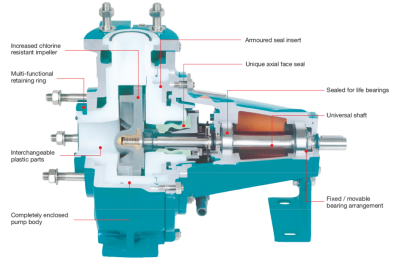
Wernert NE pumps were selected because they combine lined pump construction with robust mechanical design. For this application, the advantages included:
- UHMPE lining for abrasion and chemical resistance
- ATEX certification for hazardous area compliance
- Double mechanical self-flushing seals for improved seal reliability
- Thick-walled cast iron body for robust construction
- Sealed-for-life bearings to support reliable operation
- Armoured seal insert for additional protection
- Replaceable plastic linings to simplify maintenance
- Back pull-out design so pumps can be serviced without removing the pump head from the pipework
Selecting the right pump for corrosive slurry duties
To specify a pump for corrosive slurry transfer, AxFlow typically needs:
- Liquid chemistry and concentration
- Temperature and pH
- Solids content by percentage
- Particle size and hardness
- Required flow and head
- Suction conditions and NPSH available
- Seal requirements and flushing arrangements
- Hazardous area classification, if applicable
- Desired maintenance strategy and uptime requirements
Why buy corrosive slurry pumps from AxFlow?
AxFlow combines pump technology, material selection and application engineering to help customers manage difficult corrosive slurry duties. Whether the challenge is abrasion, chemical attack, hazardous area compliance or continuous operation, AxFlow can recommend a pump construction and seal arrangement suited to the full process requirement.
FAQs
What is a corrosive slurry?
A corrosive slurry is a liquid containing suspended solids where the liquid phase can chemically attack pump materials and the solids can cause mechanical abrasion. Examples include gypsum slurry, limestone slurry and acidic or alkaline process slurries.
What pump materials are suitable for corrosive slurries?
Material selection depends on the chemistry, temperature and solids. Lined pumps using materials such as UHMPE can be suitable where both chemical and abrasion resistance are required.
Why are standard pumps often unsuitable for corrosive slurries?
Standard pumps may suffer rapid casing, impeller or seal wear due to the combined effect of chemical corrosion and solids abrasion. Corrosive slurry duties usually require specialist materials, linings and seal arrangements.
What information is needed to size a corrosive slurry pump?
Provide the fluid chemistry, concentration, temperature, pH, solids content, particle size, required flow, required head, suction conditions and any hazardous area requirements.
Can AxFlow supply pumps for hazardous area slurry applications?
Yes. AxFlow can support hazardous area slurry applications with suitable pump technologies and certification options, including ATEX-certified pumps where required.