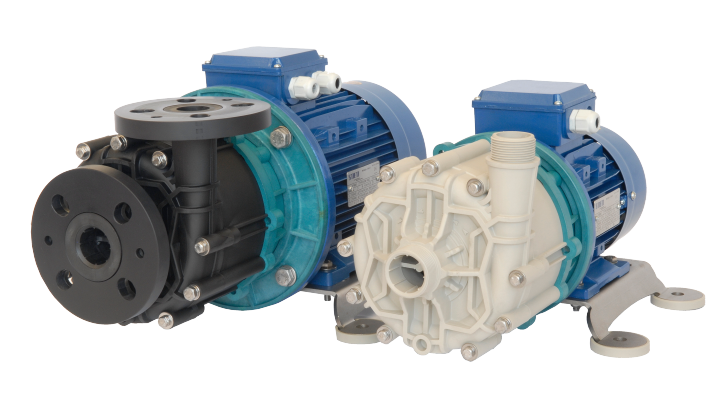
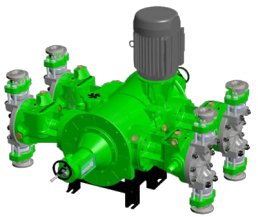
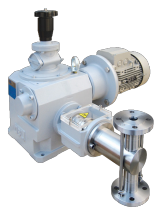
sealless pumps
AxFlow GB have a range of sealless pumps suitable for the toughest of applications.
Sealless Pumps for Critical Fluid Containment
Sealless pumps are designed for applications where eliminating the conventional rotating shaft seal can improve fluid containment, process safety and reliability. They are commonly considered when handling hazardous, toxic, corrosive, volatile, high-value or environmentally sensitive liquids where leakage from a mechanical shaft seal would carry significant consequences.
AxFlow supplies sealless pumping technologies for demanding industrial processes, including magnetic drive pumps and canned motor pumps, with options for chemical processing, petrochemical, energy, refrigeration and other containment-critical duties.
What Is a Sealless Pump?
A sealless pump is a pump that does not rely on a conventional dynamic shaft seal as the primary barrier between the process liquid and the surrounding atmosphere.
In a conventional mechanically sealed pump, a rotating shaft passes through the pump casing and the mechanical seal provides containment around that shaft. In a sealless design, torque is transmitted across a containment boundary without requiring the same type of rotating shaft penetration.
This removes the mechanical shaft seal as a potential leakage and maintenance point.
The term sealless does not mean that a pump contains no seals whatsoever. Static gaskets and O-rings may still be present within the pressure boundary. Correct materials, operating conditions, installation and maintenance therefore remain essential.
What are the main types of sealless pump?
For industrial rotodynamic pumping applications, the two principal sealless technologies are magnetic drive pumps and canned motor pumps.
Both remove the conventional mechanical shaft seal, but they transmit power to the pump in different ways.
Magnetic drive pumps
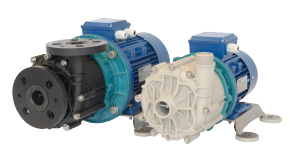
A magnetic drive pump uses a magnetic coupling to transmit torque through a sealed containment shell. The external drive and the wetted rotating assembly are therefore physically separated.
Magnetic drive technology can be applied to several pump principles and provides considerable flexibility in materials, hydraulic design and operating range.
For detailed information about magnetic couplings, available pump designs, materials and magnetic drive applications, visit our Magnetic Drive Pumps page.
Canned motor pumps
A canned motor pump integrates the pump and electric motor into a compact sealed assembly. The motor rotor and pump impeller operate as part of the enclosed rotating assembly, while the stator is isolated from the process liquid by a corrosion-resistant liner.
Depending on the design, process liquid is circulated internally to provide cooling and lubrication to components within the pump.
Canned motor pumps can provide an extremely compact solution for demanding containment duties and are widely used where reliability, limited leakage paths and reduced external equipment are important.
AxFlow supplies HERMETIC canned motor pumps for a wide range of industrial and process applications, including high-pressure, high-temperature, low-temperature and API 685 duties.
Magnetic drive or canned motor pump – which should you choose?
Neither technology is universally better. Selection depends on the liquid, operating conditions, required containment philosophy and the requirements of the installation.
| Consideration | Magnetic drive pump | Canned motor pump |
| Drive arrangement | Separate motor transmits torque through a magnetic coupling | Motor and pump form an integrated unit |
| Dynamic shaft seal | Eliminated | Eliminated |
| Containment barrier | Containment shell separates inner and outer magnetic assemblies | Motor stator is separated from the process side by the stator liner |
| Installation | Available in numerous pump technologies and configurations | Particularly compact integrated construction |
| Motor arrangement | Can use a separate conventional driver depending on design | Motor is integral to the pump |
| Typical selection driver | Flexibility of pump technology, materials and hydraulic configuration | Compact construction and high-integrity containment |
| Applicable standards | API 685 designs available where required | API 685 designs available where required |
Why use a sealless pump?
The main reason for specifying a sealless pump is usually fluid containment.
Mechanical seals are highly effective when correctly selected and operated, and remain the appropriate solution for many pumping duties. There are applications, however, where eliminating the dynamic mechanical seal can provide significant operational advantages.
Sealless technology may be considered where a release could create a safety hazard, environmental issue, loss of valuable product, contamination risk or significant maintenance requirement.
This can make sealless pumps particularly valuable for chemical processing, petrochemical production, refrigeration, energy applications and specialist industrial processes.
Selecting a sealless pump
The correct sealless pump cannot be selected from flow and pressure alone. AxFlow's engineers consider the complete process duty, including:
- Fluid name and concentration; minimum, normal and maximum flow; required head or differential pressure; minimum and maximum temperature; system and suction pressure; vapour pressure and available NPSH; viscosity and density; solids or particulate content; fluid lubricity; required materials of construction; hazardous-area classification; operating pattern and control method; and applicable standards such as API 685 or ATEX where required.
These factors determine not only pump size but whether magnetic drive, canned motor or an alternative pump technology represents the most reliable solution.
Sealless pumps for hazardous and corrosive liquids
Containment becomes increasingly important when pumping liquids that are hazardous, toxic, corrosive, volatile or environmentally harmful.
Eliminating the conventional mechanical shaft seal removes one potential route for process fluid to escape during normal operation.
Pump material remains equally important. The wetted construction must be compatible with the liquid, its concentration, operating temperature and any contaminants present.
Depending on the application, sealless pumps can be supplied in metallic, non-metallic or lined constructions to provide the required chemical resistance.
Sealless pumps for volatile and high-vapour-pressure liquids
Liquids with high vapour pressure require careful pump and system design because changes in pressure or temperature can cause flashing within the pump.
Sealless technology can be particularly valuable where the fluid also presents a containment hazard, but the internal circulation arrangement, available NPSH, vapour pressure and heat generated within the pump must all be assessed during selection.
Specialist canned motor and magnetic drive configurations are available for demanding volatile-liquid, refrigeration and low-temperature applications.
Why choose AxFlow for sealless pumps?
Selecting a sealless pump involves more than replacing a mechanically sealed pump with a seal-free equivalent.
Internal circulation, bearing lubrication, vapour pressure, NPSH, materials, temperature, solids content, differential pressure and containment requirements all influence reliability.
AxFlow provides access to both magnetic drive and canned motor pump technologies, allowing our engineers to select the design around the application rather than being restricted to a single sealless pump principle.
Our range includes solutions for general chemical transfer through to specialist high-pressure, high-temperature, low-temperature and API 685 process duties.
Frequently asked questions about sealless pumps
What does sealless mean on a pump?
A sealless pump does not use a conventional dynamic shaft seal as its primary method of containing the pumped liquid. Instead, power is transmitted to the rotating assembly without requiring the normal shaft penetration through the pressure boundary.
Are sealless pumps the same as magnetic drive pumps?
No. A magnetic drive pump is one type of sealless pump. Canned motor pumps are another major sealless technology. Both remove the conventional mechanical shaft seal but use different methods to drive the pump.
Is a canned motor pump a magnetic drive pump?
No. Although both are sealless technologies, their drive arrangements are different. A magnetic drive pump uses permanent magnets separated by a containment shell, whereas a canned motor pump incorporates the motor rotor into the enclosed pump assembly.
Are sealless pumps completely leak-proof?
Sealless construction removes the conventional dynamic shaft seal and therefore reduces an important potential leakage path. However, static seals and other pressure-containing components remain, so correct design, materials, installation and operation are still essential.
When should a sealless pump be considered?
A sealless pump should be considered where containment is particularly important, such as when pumping hazardous, toxic, volatile, corrosive, high-value or environmentally sensitive liquids, or where mechanical-seal maintenance presents an operational concern.
What is the difference between a sealless pump and a mechanically sealed pump?
A mechanically sealed pump has a rotating shaft passing through the pressure casing and uses a mechanical seal around that shaft. A sealless pump eliminates this dynamic sealing arrangement and transmits power through a sealed containment boundary.
Do sealless pumps still require maintenance?
Yes. They eliminate mechanical-seal maintenance but still contain bearings, hydraulic components and other wear parts. Correct operating conditions and periodic inspection remain important to long-term reliability.
Need help selecting a sealless pump?
Choosing between magnetic drive, canned motor and alternative shaft-seal-free pump technologies depends on much more than flow and pressure.
Send AxFlow your fluid, concentration, temperature, flow, pressure or head, suction conditions and operating requirements, and our engineers can help identify the most appropriate sealless pumping solution for your application.
Magnetic Drive Pumps
AxFlow boasts an extremely large choice of mag drive pumps.
read more about magnetic drive pumps