





AxFlow supplies marine pumps for commercial vessels, FPSOs, offshore platforms, docks and marine terminals. Applications include seawater cooling, ballast water, bilge and sludge transfer, fuel and lubricating oil, wastewater, firewater, chemicals and liquefied gases.
Marine pumping systems must operate reliably in limited spaces while handling corrosive seawater, hydrocarbons, waste fluids and volatile liquids. AxFlow offers centrifugal, vertical, side-channel, rotary vane, AODD and canned motor pumps from manufacturers including Gruppo Aturia, SERO, Blackmer, Wilden and HERMETIC.
What Is a Marine Pump?
A marine pump is selected for fluid transfer or circulation aboard a vessel or offshore installation. The term describes the application rather than one specific pump design.
The most suitable technology depends on the liquid, flow, pressure, suction conditions, installation space and required materials.
| Marine application | Common pump technology |
| Seawater cooling and ballast | Centrifugal, vertical mixed-flow or axial-flow pumps |
| Bilge, sludge and waste transfer | AODD, progressive cavity or solids-handling pumps |
| Fuel and lubricating oil | Rotary vane, gear or screw pumps |
| LNG, LPG and volatile liquids | Cryogenic canned motor or specialist side-channel pumps |
| Chemical transfer and dosing | Magnetic drive, AODD, metering or peristaltic pumps |
Marine Pump Applications
- Seawater Cooling and Ballast
- Bilge, Sludge and Wastewater
- Fuel and Lubricating Oil Transfer
- LNG, LPG and Liquefied Gas
- Chemical Dosing and Treatment
How to Choose a Marine Pump
Correct marine pump selection requires consideration of the complete operating duty.
- Flow and pressure: Define minimum, normal and maximum demand, including pipework and equipment losses.
- Fluid properties: Confirm viscosity, temperature, density, vapour pressure, solids, corrosiveness and lubricity.
- Suction conditions: Review available NPSH, suction lift, tank level and the risk of entrained air or vapour.
- Materials: Select all wetted components for seawater, fuel, chemicals or waste fluids—not the casing alone.
- Containment: Determine whether mechanical seals, double seals, magnetic drive or canned motor construction is required.
- Installation: Consider footprint, weight, noise, vibration, motor arrangement and maintenance access.
- Hazardous areas: Verify the complete certification and equipment marking where flammable fuels, solvents or gases are handled.
- Marine requirements: Confirm any vessel, flag-state, classification-society or project-specific requirements before ordering.
Side channel pumps have found significant application in LNG (liquefied natural gas) marine applications, playing a crucial role in the safe and efficient transfer of LNG on board vessels. These specialized pumps are specifically designed to handle low-viscosity fluids, making them ideal for LNG, which has a low viscosity at cryogenic temperatures.
Side channel pumps excel in providing the high-pressure capabilities required for LNG transfer, ensuring a smooth and continuous flow of the liquefied gas. They are utilized in various stages of LNG handling, including loading and unloading operations, fuel transfer between storage tanks, and LNG bunkering. With their robust construction and reliable performance, side channel pumps enable the safe and efficient transport of LNG, contributing to the growth and sustainability of the LNG marine industry while adhering to stringent safety standards.
Ethane Vessels
Side channel pumps are also extensively utilized in ethane liquefied petroleum gas (LPG) and ethane vessel applications. Ethane, as a key component of LPG, requires efficient and reliable transfer during loading, unloading, and distribution processes. Side channel pumps excel in handling low-viscosity fluids like ethane, providing the necessary pressure and flow rate for smooth and efficient operations. These pumps are capable of maintaining a continuous and pulsation-free flow, ensuring minimal downtime and maximizing productivity.
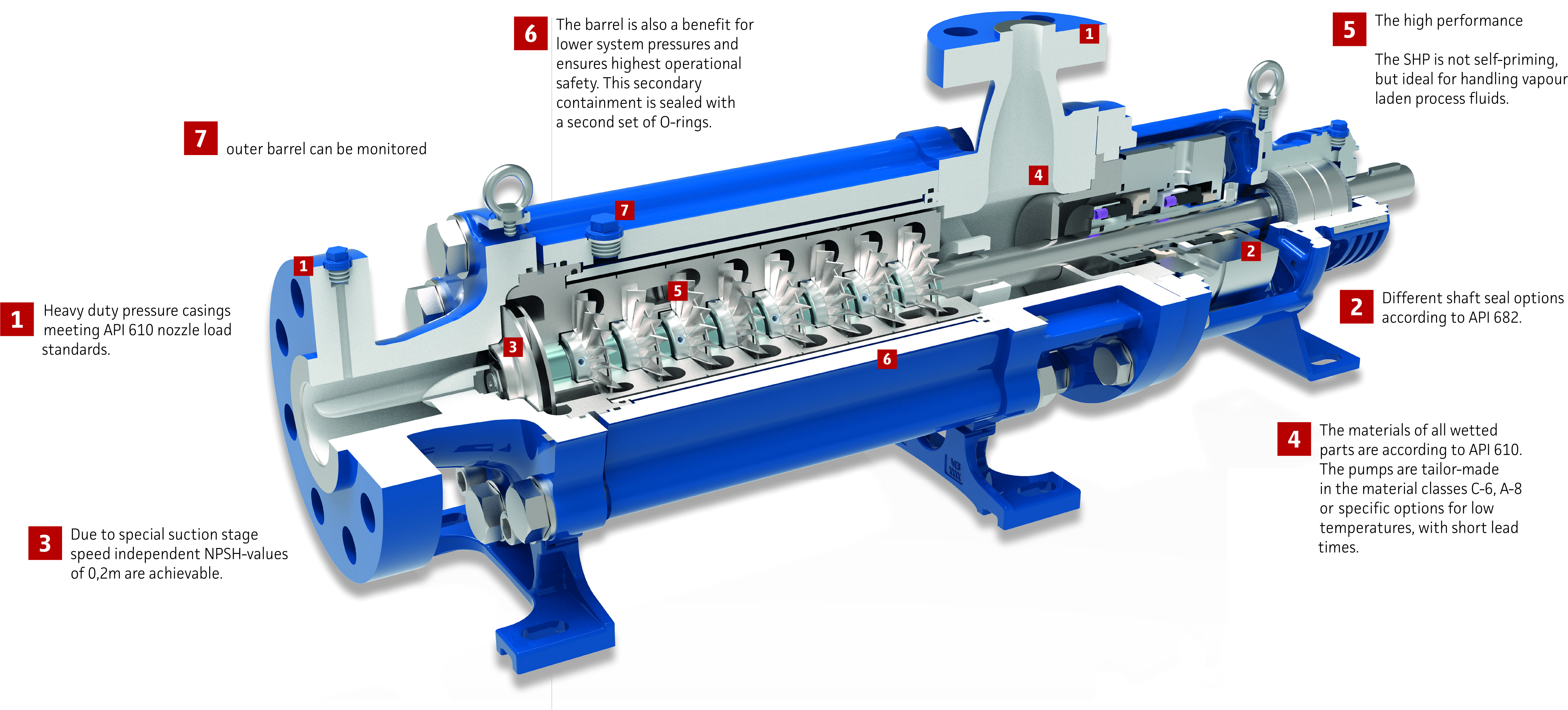
SERO HP Side Channel Pumps
Model SHP® is a new generation of SERO side channel pumps. The SHP® hydraulic remains focused on low flow applications, but now the SHP® is capable of producing heads upwards of 3500’ with a maximum allowable working pressure of 1450 psig (100bar).
Why Choose AxFlow?
AxFlow supports marine, dockside and offshore operators with:
- Marine pump sizing and technology selection
- Seawater and corrosion-resistant material advice
- Fuel, oil, bilge and ballast applications
- LNG, LPG and high-containment pump selection
- Hazardous-area pump options
- Installation and commissioning
- Pump repair and refurbishment
- Genuine spares and technical support
By reviewing the complete fluid and system duty, AxFlow can recommend a marine pump solution focused on reliability, maintainability and whole-life operating cost.
Frequently Asked Questions
What pumps are used on ships?
Ships use centrifugal, vertical, AODD, rotary vane, gear, screw, metering and canned motor pumps. The correct technology depends on whether the duty involves seawater, ballast, bilge water, fuel, oil, chemicals, wastewater or liquefied gas.
What is the best pump for seawater?
Centrifugal pumps are commonly used for seawater cooling and circulation. Vertical mixed-flow and axial-flow pumps are suited to larger seawater-lift and ballast duties. Material selection is critical because seawater is corrosive and may contain sand or marine debris.
Can AODD pumps be used as marine bilge pumps?
Yes. AODD pumps are often suitable for intermittent bilge, sludge and waste-transfer duties because they can self-prime and handle some suspended solids. The pump materials and particle passage must be checked against the actual bilge liquid.
Which pump is used for marine fuel transfer?
Rotary vane, gear and screw pumps are commonly used for marine fuel and lubricating oil. Selection depends on fuel viscosity, temperature, required flow, differential pressure and suction conditions.
What pump is used for LNG transfer?
LNG requires a cryogenic pump specifically designed for approximately −162°C service, high vapour pressure and secure containment. Submerged canned motor in-tank pumps are one established solution for LNG marine and storage applications.


