

Air-Operated Double-Diaphragm pumps are a type of positive displacement pump which consists of two pumping chambers that are alternately filled and discharged by the movement of flexible diaphragms. Compressed air is alternately fed to, and vented from, air chambers on the opposite sides of the diaphragms to create the pumping action.




AOD/AODD Pumps
16 series from 2 manufacturers
-
- Analysis
- Booster
- Circulation
- Cleaning
- Control
- Conveying
- Cooling
- Descaling
- Desinfection
- Dewatering
- Diagnostic
- Discharge
- Distribution
- Dosing
- Drain
- Extraction
- Feed
- Filling
- Filtration
- Flow Control
- Handling
- High-Pressure
- High-Temperature
- High-Volume
- Injection
- Irrigation
- Level Control
- Lift
- Lifting
- Loading
- Low-Pressure
- Medium-Pressure
- Metering
- Mixing
- Off-loading
- Powder Coating
- Pressurisation
- Process
- Processing
- Recirculation
- Recovery
- Refueling
- Replacement
- Rinsing
- Sampling
- Settling
- Spraying
- Tempering
- Transfer
- Treatment
- Unloading
- Washing
- Water-Jet Cleaning
-
- Abrasive Liquids
- Acetate
- Acids
- Adhesives
- Aluminium Oxide Slurry
- Biological Broths and Slurries
- Caustic Solutions
- China Clay Slurry
- Corrosive Liquids
- Crystalline Slurry
- Dairy Products
- Dye Pigment
- Emulsions
- Ferric Chloride
- Foam Protein
- Fruit Concentrates
- Gels
- HydrochloricAcid
- Latex
- Light Fluids
- Lime
- Low NPSH
- Low Viscosity Liquids
- Milk
- Molasses and Syrups
- Non-Newtonian Fluids
- Oil, Fats and Mayonnaise
- Paints
- Paints Resins
- Personal Care Products
- Pet Food
- Phosphoric Acid
- Sauces
- Seawater
- Sensitive and Viscous Fluids
- Separated Oil Processing
- Silver Nitrate
- Soaps and Detergents
- Solids and Abrasives
- Spirits
- Sulphuric Acids
- Surfactants
- Thixotropic Fluids
- Toxic Liquids
- Vegetable Oils
- Viscose
- Viscous Liquids
- Wort
-
- Abrasion Resistant
- Adjustable-Flow
- Automatic
- Booster Sets
- Chemically Resistant
- CIP
- Close-Coupled
- Compact
- Containment
- Corrosion-Proof
- Direct-Drive
- Double-Acting
- Electric
- Explosion-Proof
- Flange
- Heavy-Duty
- High System Pressure
- High Temperature
- High-Efficiency
- High-Flow
- High-Performance
- Horizontal Mount
- In-Line
- Intrinsically Safe
- Low Shear
- Low-Noise
- Mechanical
- Mechanical Seal
- Mixed Flow
- Mobile
- Modular
- Motorless
- Multi-Stage
- Non-Metal
- Oil-Free
- Plastic Lined
- Pneumatic
- Pulse-less
- Rotary
- Rugged
- Sanitary
- Seal-less
- Self-priming
- Single-Stage
- SIP
- Solids Handling
- Variable Speed
Do you need help finding the right pump that meets your needs?
We have experienced experts who are ready to help you!
Get in touch here


Air-operated double diaphragm pumps (AOD/AODD pumps) are versatile positive displacement pumps used for transferring and dosing a wide range of liquids—from clean chemicals to viscous, abrasive and solids-bearing fluids. AxFlow UK supplies a comprehensive range of Wilden AODD pumps, plus genuine spares and technical support to keep critical processes running reliably.

How does a diaphragm pump work
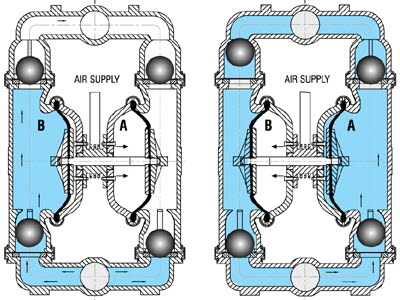
An AODD pump is a positive displacement, reciprocating diaphragm pump powered by compressed air. Instead of a rotating shaft and mechanical seal, it uses two flexible diaphragms connected by a common shaft. An internal air distribution valve (ADV) alternately pressurises one diaphragm chamber while exhausting the other, creating the suction and discharge strokes that move liquid through check valves.
The core components
- Two liquid chambers, each separated from the air side by a diaphragm
- A common diaphragm shaft linking the two diaphragms
- An air distribution valve (spool/slide or poppet style) that routes air alternately to each air chamber
- Inlet and discharge check valves (typically ball, flap or diaphragm check) on each liquid chamber to enforce one-way flow
Step-by-step cycle
-
Air is directed to Chamber A (power stroke)
The ADV sends compressed air behind Diaphragm A, pushing it inward. This reduces the volume of Liquid Chamber A and forces liquid out through its discharge check valve (inlet check closes, discharge check opens). -
Simultaneous suction on Chamber B
Because the diaphragms are linked, Diaphragm B is pulled outward at the same time. The volume in Liquid Chamber B increases, creating suction. Liquid enters through Chamber B’s inlet check valve (discharge check stays closed). -
End-of-stroke valve shift (the “flip”)
As the diaphragms reach the end of travel, a pilot mechanism (mechanical, pneumatic signal, or internal porting depending on the ADV design) triggers the ADV to switch. The previously pressurised air side begins to exhaust. -
Air is directed to Chamber B (power stroke)
Now the ADV pressurises behind Diaphragm B, pushing it inward to discharge liquid from Chamber B while Chamber A refills on suction.
This alternating action produces the characteristic pulsating flow of an AODD pump. Pulsation can be reduced with a pulsation dampener, larger air plumbing, correct suction conditions, and appropriate pump sizing.
Why buy AODD Pumps from AxFlow
AxFlow is one of the leading UK suppliers of AODD/AOD pumps with over 50 years of experience. AxFlow UK has a wide range of Air Operated Double Diaphragm pumps from Wilden and Almatec.
Air Operated double diaphragm pumps are widely used for their simple, portable construction and their ability to dry prime, and handle solids.
Air Operated Diaphragm pumps are employed in a host of fluid transfer applications ranging from circulation duties in cleanroom environments to sludge pumping. AODD Pumps are intrinsically safe by design, offering a wide range of material and elastomer options.
Selecting the right AODD pump
- Fluid/chemical, concentration and temperature
- Required flow rate and discharge pressure
- Solids content and maximum particle size (if any)
- Suction conditions (flooded or lift), hose/pipe lengths and fittings
- Preferred wetted materials and elastomers
- Any ATEX/hazardous area requirements and site air supply details
When considering heavy-duty AODD pumps with flap check and ball valves, it is important to evaluate their technical capabilities for efficiency and reliability before making a final decision.
The only significant limitation of AODD pump design is the suction pressure, which is dictated by atmospheric pressure, and can limit performance. To optimize performance, it is best to position the pump as close as possible to the tank or vessel holding the liquid.
Advantages of AODD Pumps
- Self-priming performance and strong suction capability (duty dependent)
- Handles solids and slurries better than many pump types (range dependent)
- Gentle pumping action for shear-sensitive fluids (application dependent)
- Can run stalled without damage and restart when demand returns
- No electric motor at the pump head—well suited to hazardous areas (site requirements apply)
- Simple, serviceable design with low-cost wear parts
Typical applications for AODD pumps
- Chemical transfer (acids, alkalis, solvents—materials dependent)
- Drum and IBC unloading / tank transfer
- Slurry, sludge and solids-bearing fluids (within solids capability)
- Paints, inks, adhesives and coatings
- Sump, bund and dewatering duties
- Filtration and filter press feed support (application dependent)
- Waste transfer and general plant utility pumping
In summary, the versatility, reliability, and ability to handle a wide range of fluids and conditions make air operated double diaphragm pumps a valuable tool in many industries where other pump types might struggle, and are utilised for transfer applications, with the ability to handle a range of material such as sludges, slurries, abrasive and shear sensitive fluids. Although they are robust, reliable and easy to maintain they tend to be relatively noisy, prone to icing, and are limited to low pressure applications.
AODD Pump maintenance
Good practice includes:
- Inspect diaphragms and valves when performance drops or air consumption increases
- Keep air supply clean and dry to reduce air valve issues
- Check fastener torque and manifolds periodically (design dependent)
- Use strainers/filters where debris could damage valves
- Monitor for changes in flow, pulsation, cycling rate and leakage to atmosphere
FAQs
What is an AODD pump used for?
AODD pumps are commonly used for chemical transfer, slurries, dewatering, filtration support and general plant utility duties where flexibility and reliability matter.
Can AODD pumps handle solids?
Many AODD pumps can handle solids and slurries, but capability depends on pump size, valve type and the particle size/hardness.
Are AODD pumps self-priming?
AODD pumps are commonly self-priming, but achievable suction lift depends on the pump, fluid, air supply and suction line design.
Do you supply spares and support?
Yes—AxFlow supplies Wilden pumps plus spares and technical support to keep AODD systems running reliably.

AxFlow is the leading UK supplier of AODD pumps with over 50 years experience. AxFlow UK has a wide range of Air Operated Double Diaphragm pumps from Wilden and Almatec.
